

The Grand Veymont from the Beure plateau


Description
- Departure : Beure parking, Saint-Agnan-en-Vercors
- Arrival : Beure parking, Saint-Agnan-en-Vercors
- Towns crossed : Saint-Agnan-en-Vercors, Gresse-en-Vercors, and Chichilianne
Altimetric profile
4 points of interest
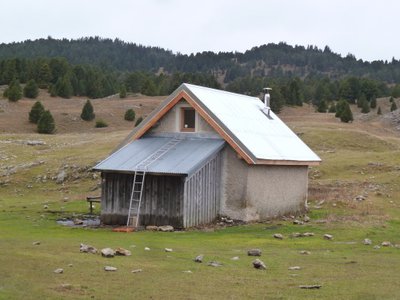
Pré Peyret - PNRV At the crossroads of several important trails, the Cabin de Pre Peyret is one of the most frequented of the massif. Located at the entrance of the high plateaus at 1600 m, this unguarded stone hut can accommodate 10 people for the night. It has a stove.The place exudes an old tradition of welcome because it is an old cabaret where those who were penniless went to drink at the Fountain of the Endettés, which bears his name well.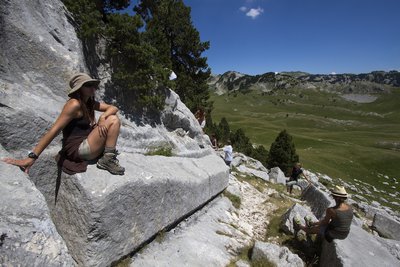
Carrières romaines de la plaine de la Queyrie - S. et M. Booth The Roman quarries
To the north-east of the Pre Peyret hut, on the Queyrie plain, an attentive eye can discover the remains of Roman quarries: fragments of columns, broken rocks ... Nearly 2,000 years ago, The man exploited this hard limestone, cut it on the spot, to descend it to Die by the Pas de Chabrinel. All this with more than rudimentary means ....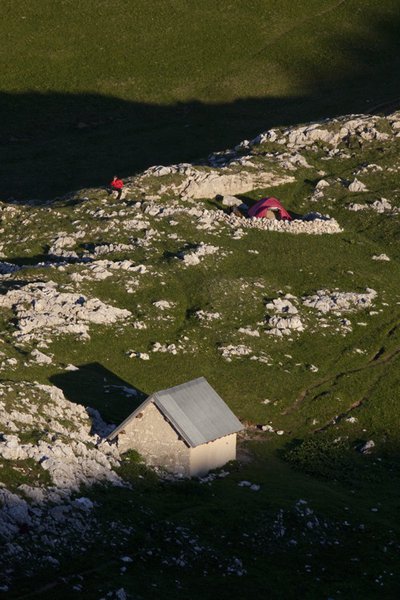
Cabane des Aiguillettes - S.M Booth Cabane of Aiguillettes
The cabin of the Aiguillettes is a former shepherd's hut dating back to the time when the pastoral units were smaller. This hut, open to the public, accommodates only 4 people by tightening a little and does not have a stove.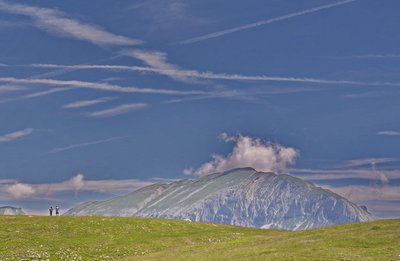
Le Grand Veymont vu du plateau de Beure - E. Charron The Grand Veymont
The highest point of the Vercors with its 2341 m, the Grand Veymont dominates the Trièves in the east and the Hauts Plateaux of the Vercors in the west. It is a continuation of the eastern barrier of the Vercors. It is limited to the north by the Pas de la Ville (1925 m), which allows the link between the Hauts-Plateaux and the Trièves, and to the south by the Pas des Chattons (1828 m). Included in the Hauts-Plateaux reserve of the Vercors, it hosts a rich biodiversity, including numerous ibexes.
Forecast
Sensitive areas
Large plateaus at an average altitude of 1,600m, these landscapes are well-known to lovers of wide open spaces where humans have discreetly left their mark over the centuries. The fauna and flora also appreciate these places, where you can observe the two emblems of the Park: the wild tulip and the black grouse. Rock birds particularly appreciate the large cliffs that border these plateaus, and mountain orchids brighten the sparse mountain pine forest. Classified as a National Nature Reserve since 1985, this heart of nature benefits from strong protection. Human activities are regulated, and certain rules apply to everyone: dogs are prohibited, even on a leash; fires are also prohibited, as are motor vehicles, except for professionals (shepherds and breeders, forest managers, and rangers); bivouacking is possible, but tents must be taken down every day. Overflight is prohibited below 300m
- Impacted practices:
- , ,
- Sensitivity periods:
- JanFebMarAprMayJunJulAugSep
- Contact:
https://www.parc-du-vercors.fr/
Black grouse - winter
- Impacted practices:
- , , ,
- Sensitivity periods:
- JanFebMarAprDec
- Contact:
Recommandations

If possible, do not practice this loop in foggy weather and have a compass and 1/25 000 card.
You are on summery areas, maybe you will meet protective dogs, often Patous. Always be sure to bypass the herds, while remaining calm while the dog identifies you, not caressing or threatening them.
Information desks
Place Pietri, 26 420 La Chapelle-en-Vercors
Access and parking
From Die, take the Col de Rousset on the D518. From the resort of Col de Rousset take the direction of the Plateau de Beure by the D815, ample parking on site.
Parking :
Report a problem or an error
If you have found an error on this page or if you have noticed any problems during your hike, please report them to us here: